
Weekend Crypto Market Crash: Bitcoin Plunges $11,000 in 72 Hours Amid $2 Billion Liquidation Cascade and $800B Valuation Wipeout
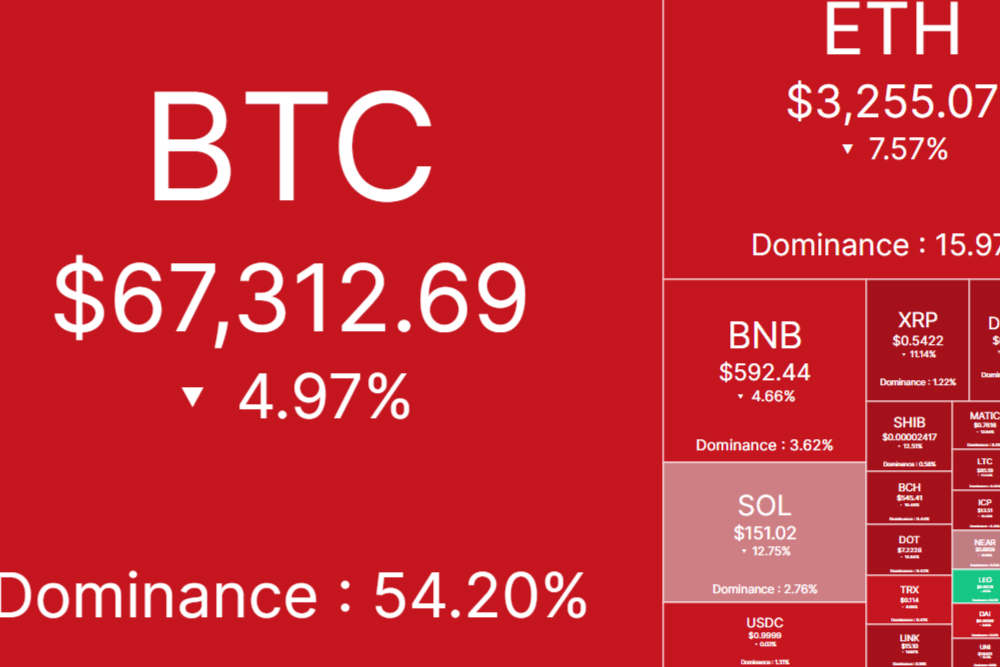
A violent wave of panic selling swept across global cryptocurrency exchanges over the weekend, wiping out hundreds of billions of dollars in digital asset valuation and catching over-leveraged traders off guard. After failing to sustain its recent technical recovery attempts, Bitcoin broke below major psychological support zones, shedding more than $5,000 in 24 hours and over $11,000 within just three days.
The downturn marks a critical inflection point for digital finance in late 2026. With Bitcoin returning to its lowest price levels of the year, market participants are reassessing risk exposure, liquidity conditions, and whether institutional buyers will step in to halt the bleeding when traditional Wall Street desks reopen.
1. Anatomy of the Weekend Sell-Off: $2 Billion Liquidated
The speed of the decline was fueled primarily by excessive leverage in crypto derivatives markets. When spot prices began slipping below key intraday support levels, automated liquidation engines across major perpetual futures platforms triggered a chain reaction of forced market sell orders.
According to real-time derivatives telemetry tracked by Coinglass, total leveraged liquidations across the crypto sector surpassed $2 billion within a 24-hour period. Even more alarming was the concentration of the flush: over $900 million in positions were wiped out in just four hours, underscoring extreme market panic and sudden liquidity evaporation.
| Market Indicator | Recorded Decline / Volume | Timeframe & Structural Impact |
|---|---|---|
| Bitcoin 24-Hour Drop | -$5,000+ | Single day; breached short-term support and triggered stop-losses. |
| Bitcoin 72-Hour Loss | -$11,000+ | 3 days; erased recent recovery bounce and hit 2026 lows. |
| 24h Leveraged Liquidations | $2.0 Billion+ | Overwhelmingly long positions caught in cascading margin calls. |
| 4-Hour Panic Flush | $900 Million+ | Peak capitulation window during thin weekend trading hours. |
| Market Cap Wipeout | -$800 Billion | Since October 6, 2026; total market down over 50% from Oct 2025 ATH. |
2. Why Weekend Order Books Amplify Bitcoin Price Crashes
To understand why an $11,000 drop materialized so rapidly over a 72-hour span, analysts point to the structural mismatch between 24/7 crypto trading venues and traditional banking rails:
- Thin Institutional Liquidity: Major market makers, hedge funds, and spot ETF authorized participants reduce active quoting over the weekend. With fewer resting bid orders on exchange order books, even moderate spot selling pushes prices down disproportionately.
- Delayed Fiat Settlement Rails: Because traditional banking wire networks (such as Fedwire and SEPA) are closed on Saturdays and Sundays, institutional desks cannot easily wire fresh USD liquidity onto exchanges to absorb distressed selling in real time.
- Algorithmic Momentum Selling: Quantitative trading bots programmed to detect order-book imbalances automatically pull bids and execute short momentum strategies during sharp breakdowns, accelerating downward velocity.
🤖 Autonomous Systems & Algorithmic Reaction: Automated software agents react within milliseconds to market and data shocks. Read our technical analysis on Elon Musk's Grok bot operating dynamics and autonomous AI system execution.
3. The $800 Billion Wipeout: From October 2025 Peak to 2026 Lows
The weekend crash is not an isolated technical glitch—it represents the latest leg of a broader multi-month contraction. According to macroeconomic market research published by The Kobeissi Letter, the total cryptocurrency market capitalization has fallen by roughly $800 billion since October 6, 2026 alone.
When measured against the historic bull-market peak achieved in October 2025, the global cryptocurrency ecosystem has now lost more than half of its total market value. Several converging macroeconomic forces explain why recovery rallies have repeatedly failed over recent weeks:
- Persistent Overhead Supply: Investors who bought near the late-2025 and early-2026 highs have used every short-term bounce as an exit opportunity to break even, creating heavy resistance ceilings.
- Global Liquidity Tightening: Cautious central bank rate guidance and elevated sovereign bond yields have increased the opportunity cost of holding non-yielding speculative assets.
- Cross-Asset De-Risking: Institutional multi-asset funds managing volatility targets have systematically trimmed high-beta exposure across both technology equities and digital assets simultaneously.
4. Altcoin Capitulation and Ecosystem Resilience
While Bitcoin's $11,000 three-day drop captured global headlines, secondary digital assets experienced severe contagion. Data across CoinMarketCap shows that major Layer-1 smart contract tokens, decentralized finance (DeFi) protocols, and mid-cap altcoins suffered double-digit percentage losses as traders rotated out of illiquid pairs back into stablecoins or Bitcoin.
During deep market drawdowns, investor focus inevitably shifts away from short-term price speculation toward real-world utility, active user retention, and sustainable tokenomics—separating resilient networks from purely momentum-driven projects.
📈 Ecosystem Strategy & Long-Term Outlook: As market turbulence tests digital networks, explore how alternative community-driven ecosystems are positioning themselves in our Pi Network 2026 comprehensive strategic market analysis.
5. Can the Crypto Market Recover Soon? 4 Key Catalysts to Watch
Despite extreme fear dominating market sentiment, historical crypto market cycles demonstrate that multi-billion-dollar liquidation flushes often mark local exhaustion points. However, for Bitcoin and the broader market to stage a durable recovery rather than another failed dead-cat bounce, analysts highlight four essential catalysts:
- 1. Spot ETF Net Inflow Stabilization: Wall Street institutional demand via spot Bitcoin ETFs must flip from net outflows back to consistent daily accumulation once traditional markets open on Monday.
- 2. Derivatives Funding Rate Reset: A complete reset in perpetual futures funding rates and open interest reduces systemic fragility, allowing organic spot buyers to rebuild support without immediate liquidation risk.
- 3. Reclaiming Broken Technical Support: Bulls must decisively reclaim the breakdown zone lost over the weekend on high spot trading volume to invalidate the bearish continuation pattern.
- 4
Comments
Post a Comment